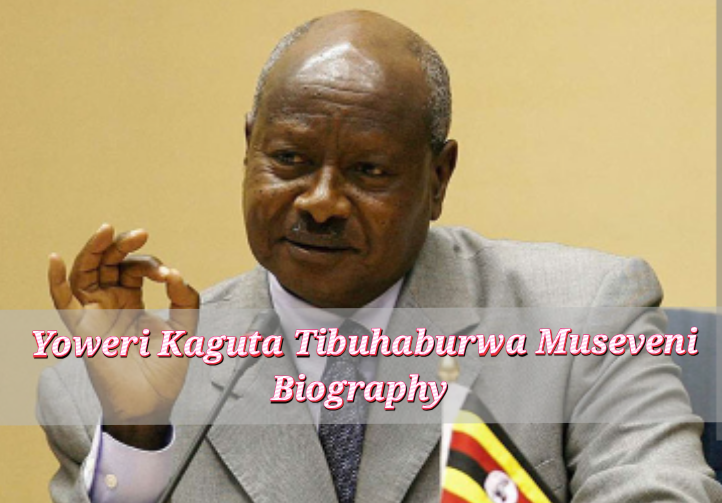
Yoweri Kaguta Tibuhaburwa Museveni is a Ugandan politician and former military officer who has served as the President of Uganda since January 1986. Born in Ntungamo, Uganda, he is a Ugandan national known for leading a guerrilla war that brought him to power after years of instability under previous regimes. Museveni has shaped modern Uganda through policies focused on economic recovery, stability, and regional influence, though his long tenure has drawn both praise and criticism.
Over more than four decades in office, Museveni has guided Uganda from a war-torn nation to one with notable economic growth and improved infrastructure. His leadership began with a promise of fundamental change, and he has remained a central figure in East African politics. This biography explores his journey from humble beginnings to his role as one of Africa’s longest-serving leaders.
Yoweri Kaguta Tibuhaburwa Museveni Early Life
Yoweri Kaguta Tibuhaburwa Museveni was born on 15 August 1944 in Ntungamo, in what was then the British Protectorate of Uganda, now part of southwestern Uganda. He grew up in a peasant pastoralist family of the Hima ethnic group within the Ankole region. His father, Amos Kaguta, was a cattle keeper who had served in the King’s African Rifles during World War II, and his mother was Esteri Kokundeka Nganzi. The family name Museveni derives from “Abaseveni,” referring to soldiers in the Seventh Regiment.
Life in a nomadic pastoral community exposed young Museveni to challenges such as land displacement caused by colonial policies. These early experiences fueled his awareness of social injustices. The family moved around in the Ankole area, where children often missed formal schooling due to their lifestyle. Museveni witnessed exploitation by colonial authorities and local collaborators, which later influenced his political views. He developed a strong sense of determination to fight inequality from a young age.
Yoweri Kaguta Tibuhaburwa Museveni Education
Museveni attended Kyamate Elementary School, Mbarara High School, and Ntare School for his early education. He showed academic promise and a keen interest in politics during his school years. He applied to Makerere University but faced rejection over citizenship documentation issues. With help from Tanzanian connections, he gained admission to the University of Dar es Salaam in Tanzania.
At the University of Dar es Salaam, Museveni studied economics and political science, graduating with a Bachelor of Arts degree in 1970. The university environment, influenced by President Julius Nyerere’s pan-Africanist ideas, proved progressive. Museveni engaged deeply with thinkers like Frantz Fanon, Karl Marx, Vladimir Lenin, Walter Rodney, and Mao Zedong. He wrote a thesis on the applicability of revolutionary violence in post-colonial Africa.
While at university, he founded the University Students’ African Revolutionary Front, a leftist activist group. He led a student delegation to FRELIMO-held areas in Mozambique for military training and supported African liberation movements. These experiences solidified his commitment to anti-colonial and revolutionary ideals.
Yoweri Kaguta Tibuhaburwa Museveni Career
Museveni’s career blended intellectual pursuits, military action, and politics. After university, he briefly joined Uganda’s intelligence service under President Milton Obote. Following Idi Amin’s 1971 coup, he went into exile in Tanzania and formed the Front for National Salvation (FRONASA) in 1973 to oppose Amin’s regime.
FRONASA participated in the 1979 Uganda-Tanzania War, which helped overthrow Amin. Museveni held positions in transitional governments, including Minister of Defence and Vice-Chairman of the Military Commission. In the disputed 1980 elections, widely seen as rigged in favor of Obote, Museveni ran under the Uganda Patriotic Movement but lost. He then launched the National Resistance Army (NRA) and National Resistance Movement (NRM) to fight Obote’s second regime.
The Ugandan Bush War began in 1981 with Museveni and a small group of fighters. Despite limited resources, the NRA grew through discipline and local support. In 1985, after a coup removed Obote, Museveni continued the struggle against the new military junta. On 26 January 1986, NRA forces captured Kampala, and Museveni was sworn in as president on 29 January. He declared it a fundamental change rather than a mere change of guard.
As president, Museveni focused on economic reforms, partnering with the IMF for recovery programs. He restored security, reduced inflation, and promoted private enterprise. Uganda joined regional efforts, including interventions in neighboring conflicts. His government introduced the Ten-Point Programme, emphasizing democracy, national unity, economic self-reliance, and social services.
Museveni initially operated under a no-party system to avoid ethnic divisions but later accepted multiparty politics after a 2005 referendum. He has won multiple elections, most recently in 2026, though many faced allegations of irregularities. His administration has addressed insurgencies, including against the Lord’s Resistance Army, and supported HIV/AIDS prevention through the ABC campaign (Abstain, Be faithful, use Condoms).
Yoweri Kaguta Tibuhaburwa Museveni Personal Life
Museveni married Janet Kataaha Kainembabazi in 1973. Janet has served as First Lady and held positions such as Minister of Education and Sports. The couple has four children: Muhoozi Kainerugaba, a senior military officer; Natasha Karugire, a fashion designer and consultant; Patience Rwabwogo, a pastor; and Diana Kamuntu. They also have several grandchildren.
Museveni is a member of the Anglican Church of Uganda. His family has remained supportive throughout his political journey, including during exile and the bush war years. Janet managed family responsibilities during periods of instability while contributing to national programs, particularly in education and women’s empowerment.
Yoweri Kaguta Tibuhaburwa Museveni Achievements
Museveni’s presidency brought relative stability to Uganda after decades of turmoil. The economy grew significantly, with GDP expanding many times over since 1986 through capitalist reforms, investment promotion, and infrastructure development. Road networks improved dramatically, and sectors like banking and industry expanded.
His government introduced universal primary education in 1997 and universal secondary education later, boosting school enrollment. Adult literacy rates rose notably. Healthcare initiatives, especially the fight against HIV/AIDS, turned Uganda into a regional success story, reducing infection rates substantially.
Poverty levels declined as agricultural modernization and programs like Operation Wealth Creation supported rural communities. Women gained greater political participation, with affirmative actions leading to increased representation. Museveni played roles in regional peace efforts and served as Chairman of the Organisation of African Unity and later the Non-Aligned Movement.
Infrastructure projects, access to safe water, and tourism promotion marked further progress. Uganda became more integrated in the East African Community, enhancing trade and cooperation.
Conclusion
Yoweri Kaguta Tibuhaburwa Museveni rose from a pastoralist background to lead Uganda for over four decades. His early commitment to justice and liberation shaped a career defined by resilience and strategic vision. While he restored stability and drove economic gains, his long rule has sparked debates about governance, democracy, and succession. Museveni’s legacy remains a mix of transformative achievements and ongoing challenges as Uganda continues to evolve under his leadership. His story reflects the complexities of post-colonial African politics, where one leader’s determination can reshape a nation’s trajectory.
FAQs
What is Yoweri Museveni’s full name and date of birth?
Yoweri Kaguta Tibuhaburwa Museveni was born on 15 August 1944.
Where was Yoweri Museveni born?
He was born in Ntungamo, in southwestern Uganda.
How long has Yoweri Museveni been president of Uganda?
He has served as president since 29 January 1986, making him one of the longest-serving leaders in Africa.
What are some key achievements of Yoweri Museveni’s presidency?
Key achievements include economic growth, infrastructure development, improved education access, and successful HIV/AIDS reduction campaigns.
Who is Yoweri Museveni’s wife?
He is married to Janet Kataaha Museveni, who has played active roles in government and social initiatives.