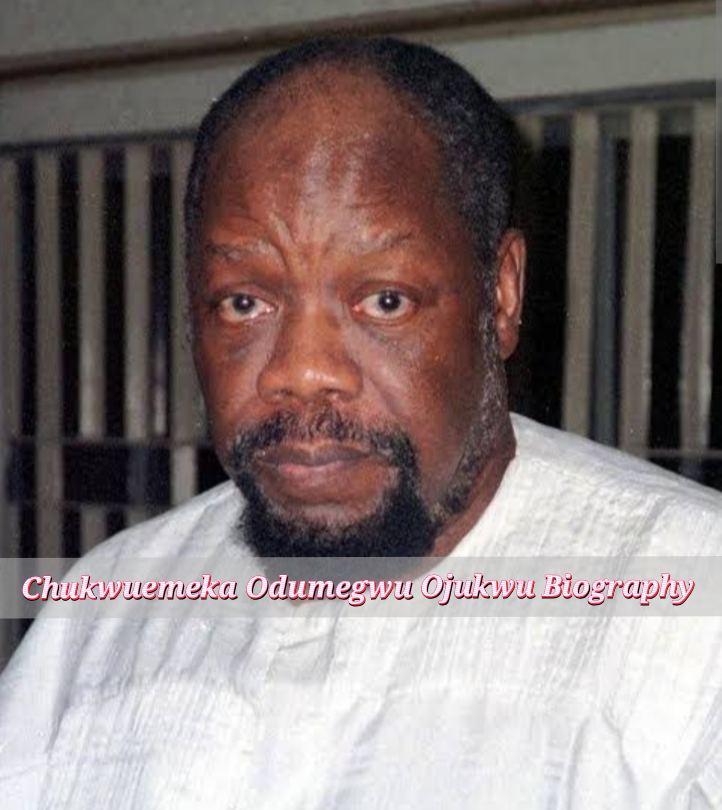
Chukwuemeka Odumegwu Ojukwu was a prominent Nigerian military officer, politician, and leader of the secessionist Republic of Biafra during the Nigerian Civil War. Born into wealth as the son of one of Nigeria’s earliest billionaires, he chose a path of public service and military leadership over business. His declaration of Biafran independence in 1967 made him a central figure in one of Africa’s most tragic conflicts, shaping Nigeria’s history and the Igbo identity.
Ojukwu remains a complex and divisive personality. To many in the Igbo community, he is a hero who defended his people against perceived threats. To others, he is remembered for leading a secession that resulted in immense suffering. His life reflects themes of privilege, principle, leadership, and resilience in post-colonial Africa.
Chukwuemeka Odumegwu Ojukwu Early Life
Chukwuemeka Odumegwu Ojukwu was born on 4 November 1933 in Zungeru, British Nigeria (now in Niger State). He was the son of Sir Louis Odumegwu Ojukwu, a wealthy Igbo businessman and transport magnate who became one of Nigeria’s first billionaires through ventures in textiles, stores, and transportation during the colonial era. His mother lived in Zungeru at the time of his birth, and his father later reclaimed him.
Ojukwu grew up in privilege but experienced a diverse cultural upbringing. World War II influenced his early schooling. He attended St. Patrick’s School and CMS Grammar School in Lagos before enrolling at King’s College, Lagos in 1944. At age 13, his father sent him to Epsom College in Surrey, England, for advanced education, where he excelled in academics and sports such as rugby, javelin, and discus.
He later studied at Lincoln College, University of Oxford, initially considering law but switching to modern history. He earned a bachelor’s degree in 1955 and later a master’s. While at Oxford, he joined the West African Students’ Union and played rugby. This elite education equipped him with intellectual depth and exposure to global ideas, which influenced his later political views.
Chukwuemeka Odumegwu Ojukwu Education
Ojukwu received a strong blend of Nigerian and British education. In Nigeria, he attended top colonial-era schools like King’s College. In England, Epsom College provided rigorous academics and character building. At Oxford, he honed critical thinking skills through history studies, which helped him analyze complex political situations. He also briefly engaged with military training later at Mons Officer Cadet School. His educational journey fostered a sense of confidence and global perspective uncommon among many of his contemporaries.
Chukwuemeka Odumegwu Ojukwu Career
Ojukwu returned to Nigeria in 1955 and joined the civil service as an Assistant District Officer in Udi, Eastern Region. He served in various postings, learning local languages and customs despite his privileged background. Dissatisfied with administrative work and his father’s influence, he enlisted in the Nigerian Army in 1957 as a private, against family wishes. His education quickly earned him a commission.
He trained in Ghana and England, rising rapidly through the ranks. By 1961, he had become a captain and later a major. He participated in United Nations peacekeeping in the Congo Crisis as an adjutant. Promotions continued, and by 1964 he commanded the 5th Battalion in Kaduna.
Following the January 1966 military coup, Major General Johnson Aguiyi-Ironsi appointed him Military Governor of the Eastern Region. Ethnic tensions escalated after a July 1966 counter-coup and anti-Igbo pogroms in the North. Ojukwu advocated for greater regional autonomy to protect Igbo interests. On 30 May 1967, he declared the Eastern Region independent as the Republic of Biafra, becoming its leader and head of state.
The Nigerian Civil War (1967–1970) followed. Ojukwu led Biafran forces as a general. The conflict caused over a million deaths, mostly from famine due to the federal blockade. Biafra gained international attention through images of starving children, humanitarian airlifts, and Ojukwu’s media engagements. Biafra surrendered in January 1970. Ojukwu fled to Côte d’Ivoire, where he received asylum.
He returned to Nigeria in 1982 after a pardon. He joined politics with the National Party of Nigeria but faced setbacks, including detention after a 1983 coup. In later years, he ran for president under the All Progressives Grand Alliance in 2003 and 2007 without success. He also participated in constitutional conferences.
Achievements include his rapid military rise, leadership during a pivotal historical moment, and advocacy for Igbo self-determination. He highlighted humanitarian issues on the global stage and inspired discussions on federalism in Nigeria. His oratory and intellectual contributions left a lasting mark on Nigerian discourse.
Chukwuemeka Odumegwu Ojukwu Net Worth
Ojukwu came from immense wealth through his father, whose fortune was estimated in billions in today’s terms. However, he pursued military and public service rather than inheriting or expanding the family empire. No precise personal net worth figures are widely documented for Ojukwu himself, as his focus remained on leadership amid war and politics rather than personal accumulation. His lifestyle reflected comfort but not ostentatious display after the war years.
Chukwuemeka Odumegwu Ojukwu Personal Life
Ojukwu married multiple times. His first wife was Elizabeth Okoli in 1956. His second, Njideka Onyekwelu (married around 1964), stood by him during the war and exile; they had children including Emeka Jr. and Okigbo. He had a relationship with Stella Onyeador, with whom he had a child. In 1994, he married Bianca Onoh, a former beauty queen and diplomat. They had three children: Afamefuna, Chineme, and Nwachukwu. He had seven children in total.
His personal life often intersected with his public role, facing challenges from exile and political pressures. He earned the title Ikemba of Nnewi, reflecting cultural respect in his homeland.
Conclusion
Chukwuemeka Odumegwu Ojukwu lived a life defined by bold choices and historical consequence. From privileged beginnings to leading a secessionist state, he embodied courage and conviction. The Biafran War remains a painful chapter in Nigerian history, yet Ojukwu’s legacy continues to spark debate on unity, justice, and self-determination. He died on 26 November 2011 in London at age 78. His body received a state funeral in Nigeria with full military honors, attended by thousands. Ojukwu’s story reminds us of the complexities of leadership in diverse nations and the enduring impact of individual decisions on collective destinies. His vision for equity influences Nigerian politics and Igbo identity to this day.
FAQs
Who was Chukwuemeka Odumegwu Ojukwu?
Chukwuemeka Odumegwu Ojukwu was a Nigerian soldier and politician who served as the leader of the Republic of Biafra during the Nigerian Civil War from 1967 to 1970.
When and where was Ojukwu born?
He was born on 4 November 1933 in Zungeru, British Nigeria.
What was Ojukwu’s role in the Nigerian Civil War?
As head of Biafra, he declared independence to protect the Igbo people and led the region through the conflict against federal Nigerian forces.
How many children did Ojukwu have?
He had seven children from his marriages.
When did Ojukwu die?
He died on 26 November 2011 in London, England.
What is Ojukwu’s legacy in Nigeria?
He is viewed as a hero by many Igbos for defending their interests and as a controversial figure by others for the secession that led to war. His life highlights issues of ethnicity, federalism, and leadership.